


The month ends. The demand doesn’t. Rethinking health observance marketing.

Every October, breast health is everywhere. Every February, heart health takes center stage. And every June, men’s health gets its moment.
Health observances give healthcare marketers something incredibly valuable: a built-in reason to start a conversation. They create urgency, generate content opportunities and give organizations a natural hook for reaching audiences who may otherwise tune out healthcare messaging.
But there’s a problem: the calendar changes; patient needs don’t.
In 2024, life expectancy in the U.S. was 76.5 years for men compared with 81.4 years for women — a 4.9-year gap.1 The need to engage men in their health doesn't begin in June and disappear in July. The same is true for breast health, heart health, cancer screening, and virtually every other health priority that gets its moment on the calendar.
If a service line is a strategic growth priority for your organization, its marketing shouldn’t disappear when the awareness month ends. The opportunity is to use health observances not as the endpoint of a campaign, but as the catalyst for a broader, year-round strategy.
For healthcare marketers, that raises the question: What if the awareness month isn't the campaign? What if it's the catalyst?
1. Use the moment, but don’t let the calendar define the strategy
Health observances can be powerful campaign accelerators. They give marketers a timely topic to put in front of consumers and a reason to engage people around conditions they may otherwise avoid. That matters, particularly for audiences who aren't actively looking for care.
But an observance alone doesn't create demand. It creates an opportunity to capture attention.
If someone engages with your men's health content in June, for example, does the conversation end when June does? Or can that interaction become the starting point for a longer-term journey around cardiovascular health, digestive health, urology, or other areas where that individual may be more likely to need care?
The same principle can apply to almost any observance. Breast Cancer Awareness Month can be a catalyst for conversations around screening, diagnostic services, oncology, and survivorship. Heart Month can open the door to conversations around prevention, cardiology, risk assessment, and ongoing management.
But those conversations don't have to end on the last day of the month. When marketers understand the audiences behind an observance — and the health needs and behaviors that matter to them — they can build campaigns that remain relevant long after the ribbon comes down.
The goal isn't to manufacture urgency for 30 days. It's to use a moment of heightened awareness to create momentum that lasts.
2. An awareness moment is only valuable if it changes behavior
Healthcare marketing has gotten very good at raising awareness. The harder job is turning awareness into action. And the gap isn't necessarily a lack of concern.
A 2024 Cleveland Clinic survey found that 87% of men were concerned about how their current health habits could affect their health in the future. Yet the survey also found meaningful gaps in preventive behaviors: 61% of Gen X and Boomer men reported getting a yearly physical, compared with just 32% of Millennial and Gen Z men.2
The implication for marketers is important: people can care about their health without taking action.
A consumer may read an article about heart health, watch a video about breast cancer screening, or take a health risk assessment (HRA) during an awareness month. Those interactions matter, but they aren’t the outcome. Rather than measuring the success of an observance campaign by how much attention it generated, marketers should ask whether it helped move people closer to care.
Did someone search for a provider? Explore a service? Request more information? Schedule an appointment? Those actions tell a much more meaningful story than impressions alone.
And importantly, they don't have to happen during the observance itself. An interaction in June might lead to an appointment in July. A screening message in October might prompt someone to act months later.
That shift — from “Is my audience engaging?” to “Is my audience moving toward care?” — changes how marketers think about the campaign itself. It also changes how success should be measured.
3. Build around the audience, not just the observance
A common approach to health observance marketing is to start with the calendar: June is Men's Health Month. What should we promote?
A more strategic approach starts with the audience: Which patients are we trying to reach? What health needs are relevant to them? What might be preventing them from seeking care? And what action do we want them to take?
That distinction matters.
The same observance can represent very different opportunities depending on the audience you're trying to reach. For one audience, the priority might be preventive screening. For another, it might be managing an existing condition. For another, it might simply be establishing a relationship with a primary care provider.
The campaign should reflect those differences. Instead of treating an awareness month as a reason to broadcast one message to a broad demographic, marketers can use it as an opportunity to identify the people most likely to benefit from the conversation — and the care their health needs may lead them toward.
That's how an observance becomes more than a content calendar entry. It becomes an audience strategy.
4. Give high-intent audiences somewhere to go
Attention is only valuable if you give people a path forward. That means connecting health content and messaging to experiences that make taking the next step easier.
A consumer who sees a screening message shouldn't have to figure out what to do next. Neither should someone who realizes their symptoms warrant a conversation with a physician. The experience should make the next step clear and easy to take.
That might mean finding a provider, locating a convenient care site, completing a HRA, exploring a service, or scheduling an appointment. The right destination depends on the audience and the service line. But the principle is the same: Don't make consumers figure out what to do next.
The gap between awareness and action is particularly clear in preventive care. CDC research published in 2025 found that 65.7% of adults ages 45–49 had never been screened for colorectal cancer, despite the recommended screening age having been lowered to 45 in 2021.3
Awareness of the recommendation is one thing. Acting on it is another. The opportunity isn't simply to tell people that screening matters. It's to make the next step easier to take.
If your campaign is successful at creating interest, the digital experience should help turn that interest into action. This is especially important for audiences who may already be hesitant to seek care. Every additional barrier — from an unclear CTA to a disconnected digital experience — creates another opportunity for them to stop.
5. Keep the campaign working after the calendar moves on
This is where an observance can become an always-on growth strategy. The content created for an awareness month doesn't necessarily have an expiration date. The audience that engaged with it doesn't disappear when the month ends. And the service-line opportunity certainly doesn't disappear.
Instead, marketers can build on that initial moment:
- Continue reaching people who engaged but didn't act.
- Introduce related content based on demonstrated interests.
- Connect audiences to relevant service lines and providers.
- Use search and other channels to capture people who enter the journey later.
- Refresh creative and messaging while maintaining continuity with the original campaign.
- Re-engage audiences around new or timely reasons to act.
The result is a shift from campaigns that peak and disappear to marketing that builds momentum over time.
The awareness month becomes the spark, not the entire fire.
6. Measure the care, not just the campaign
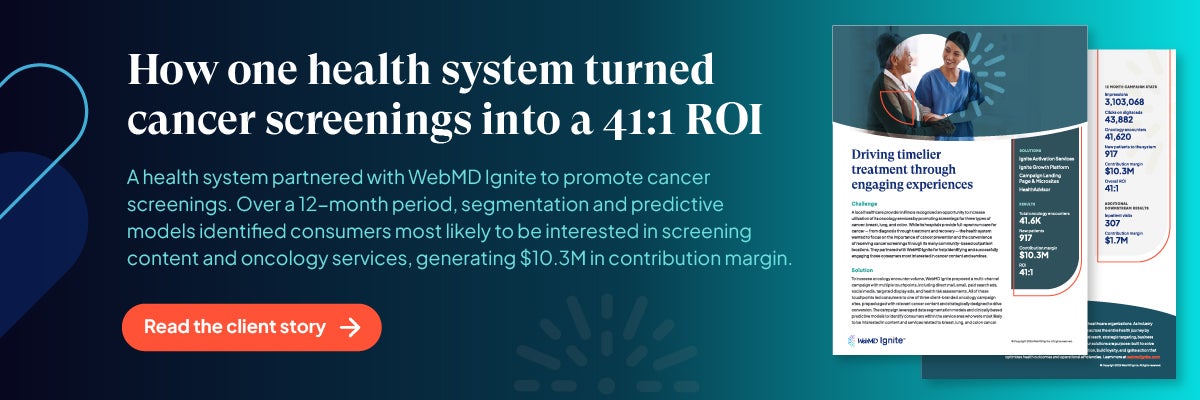
Perhaps the biggest opportunity in health observance marketing is also the most overlooked: proving what the campaign actually contributed to the business. Impressions, clicks, and engagement can tell marketers whether a message generated activity. But they don't necessarily tell you whether that activity generated care.
Connecting marketing engagement to downstream encounters creates a much more meaningful picture. It allows marketers to understand which audiences engaged, which actions they took and whether those interactions ultimately translated into patients and financial value.
That's particularly important for service lines where marketing investment is expected to contribute to growth. When marketers can connect an interaction to a patient who ultimately receives care, the conversation changes.
It's no longer simply: “How did the campaign perform?” It's: “What did the campaign help our health system accomplish?” That is the difference between measuring marketing activity and proving marketing value.
Final thought: the month is the moment, not the strategy
Health observances aren't going away — and they shouldn't. They're valuable opportunities to focus attention on important health issues and meet consumers with timely, relevant messaging.
But the smartest healthcare marketers won't treat an observance as a 30-day campaign. They'll treat it as a launch point.
Use the moment to capture attention. Use data to understand who is engaging and what they need. Use relevant content and digital experiences to move people toward care. And use closed-loop measurement to understand what that engagement actually delivered.
Because when the month ends, the patient need remains. And if the service line matters to your organization, the marketing opportunity does too.
Sources:
- CDC. Mortality in the United States, 2024. https://www.cdc.gov/nchs/products/databriefs/db548.htm
- Cleveland Clinic. National Cleveland Clinic Survey Examines Generational Divide in Men's Health. https://newsroom.clevelandclinic.org/2024/09/04/national-cleveland-clinic-survey-examines-generational-divide-in-mens-health
- CDC. Use of Cancer Screening Tests, United States, 2023. https://www.cdc.gov/pcd/issues/2025/25_0139.htm