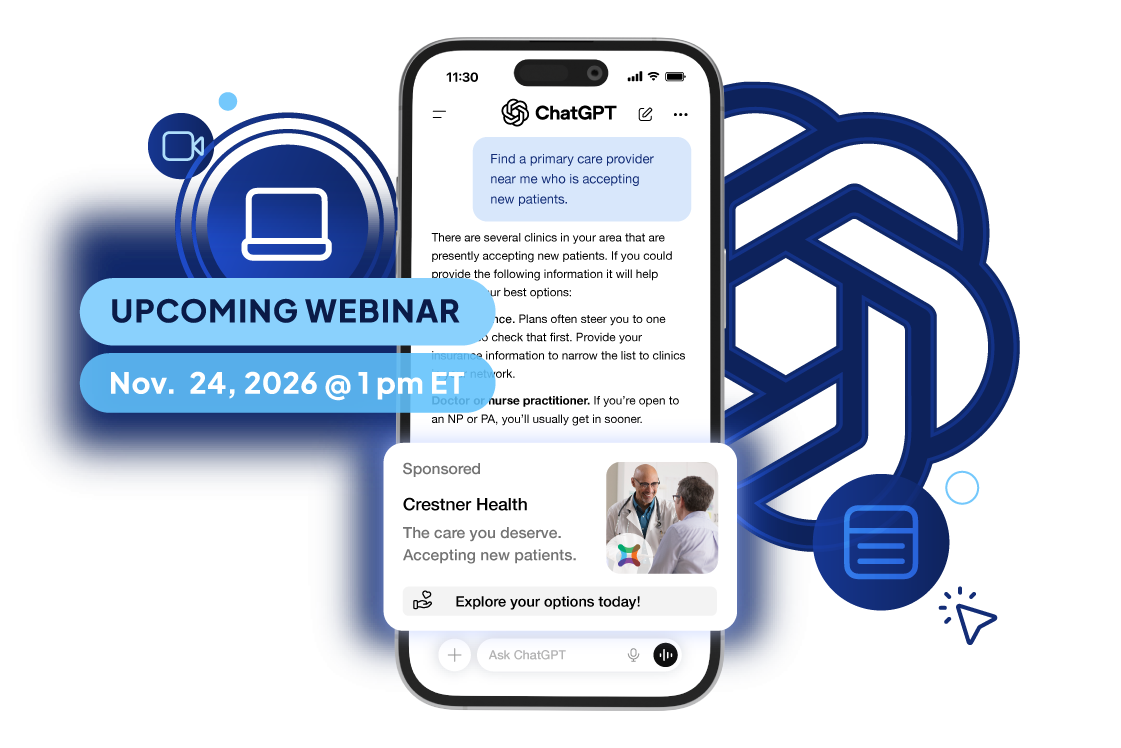
Healthcare discovery is going conversational. Is your strategy?

Introduction
Healthcare discovery used to follow a predictable path. A consumer felt a symptom, searched online, scanned results, and clicked through to find a provider or service. That path still exists. But it no longer tells the whole story.
The change isn't just where people search. It's how they explore their options, ask follow-up questions, and decide what to do next. More consumers are using conversational AI tools to ask open-ended questions about their health, explore care options, and gather information before they ever interact with a healthcare provider's website or directory listing. This isn't replacing traditional search. It's expanding the landscape where discovery happens.
The data suggests this is more than a passing trend. In a March 2026 KFF poll, 32% of U.S. adults said they had used AI chatbots for health information or advice in the past year.1 Nearly three in ten had sought physical health information, including information about symptoms, conditions, and treatment options. For healthcare marketers, that expansion carries real stakes. If your organization's services and resources aren't visible in the environments where people are actively forming decisions, you're not losing a click. You're missing a connection with someone who needed to find you.
AI in healthcare marketing isn't a distant consideration. It's a present-tense strategic challenge.
This blog covers four things healthcare marketing leaders should be thinking about now: how healthcare discovery is expanding beyond search, why visibility now requires both organic and paid thinking, how emerging channels can help people discover services and resources beyond appointment acquisition, and how to evaluate these opportunities with discipline rather than hype.
Discovery is expanding beyond the search bar
For years, healthcare discovery followed a familiar pattern. A consumer had a question, typed it into a search engine, and worked through a list of results. That behavior hasn't disappeared. But a new layer is forming alongside it.
Conversational AI tools are giving consumers a different way to explore health questions. Instead of scanning links, they're asking open-ended questions and receiving synthesized, dialogue-style answers. They're exploring symptoms, comparing care options, and looking for local providers through a format that responds and adapts rather than simply lists.
This shift is part of a broader change in how people seek information. Pew Research Center reported in June 2026 that 49% of U.S. adults had used AI chatbots, up from 33% in 2024.2 Its research also found that 60% of adults had read AI-generated summaries at the top of search results. This isn't a wholesale shift away from search. It's an expansion of where and how discovery happens. Consumers are using more tools, in more contexts, to gather information before they ever reach a healthcare provider's website.
For healthcare marketing leaders, that expansion carries real strategic stakes. If your organization's services, care locations, and community resources aren't visible where people are actively forming decisions, you're not just missing traffic. You're missing the chance to connect people with relevant care at the moment they are trying to understand what to do next.
The behavior is still developing. Adoption varies by audience, use case, and geography. But the directional shift is clear enough to warrant attention now, before the gap between where consumers look and where healthcare organizations invest becomes difficult to close.
The strategic question isn't whether traditional search still matters. It's whether your organization is prepared for a discovery journey that now spans search results, AI-generated summaries, conversational tools, and paid placements in emerging environments, and whether your visibility strategy reflects that reality yet.
Visibility is now a strategic imperative, not a channel tactic
Visibility used to mean one thing: ranking well on a search engine results page. That definition no longer covers enough ground.
Today, healthcare marketing requires a broader view. Being visible means being discoverable and accurately represented across search, conversational AI, voice, and social platforms. Consumers move between these environments fluidly. Your organization needs to show up consistently across all of them.
That starts with treating digital visibility as a strategic priority, not a channel-by-channel afterthought. Healthcare providers should regularly audit how their organization, services, care locations, and programs appear across the digital ecosystem. The question isn't just "Do we rank?" It's "Are we findable, and are we accurately represented, wherever our audiences are looking?"
This matters more now because of how AI-driven tools work. Conversational AI platforms synthesize information from multiple sources to generate their responses. That means the accuracy and completeness of your digital footprint can influence how your organization is described in those environments. Outdated information, incomplete listings, or gaps in your online presence can create inconsistencies that affect how people understand your services and care options.
But visibility is not a single lever. Organic discoverability, the information AI tools draw on, and paid advertising each play different roles. Improving your digital footprint can strengthen how your organization is represented across the web, but it does not guarantee inclusion in an AI-generated answer. Likewise, a paid placement can introduce relevant services in a new discovery environment, but it is not the same as being cited or recommended organically. Healthcare marketing leaders need to understand how these levers complement one another without overstating what any one of them can do.
Healthcare digital advertising plays a role here too. Paid placements in these environments can complement organic visibility efforts, helping your organization reach audiences in new discovery environments and introduce relevant services when people are exploring their options.
New channels need to serve real healthcare needs, not just consumer acquisition
When a new advertising channel emerges, the instinct is often to ask: how do we use this to acquire more patients? That's a reasonable question. But it's not the only one worth asking.
Conversational AI environments create an opportunity to do something broader. Healthcare organizations can use these channels to help people discover local services, care locations, community health programs, and resources that often remain underutilized or overlooked. The goal isn't only to fill appointment slots. It's to make relevant care easier to find, easier to understand, and easier to act on when people are still figuring out what kind of help they need.
Consider the parent searching for pediatric urgent care hours on a Sunday night. The caregiver looking for memory care programs close to home. The person recently diagnosed with a chronic condition, trying to understand what support exists in their community. These are real discovery moments. They don't always start with a referral or a search engine. And they don't always end in a scheduled appointment. But they represent exactly the kind of connection a healthcare provider exists to make.
This broader view matters because information-seeking and care-seeking aren't always the same thing. Someone exploring a new diagnosis may need education before they're ready to choose a provider. A family looking for community-based support may not be searching for an appointment at all. And someone comparing local services may not yet know which type of care is appropriate.
This is where healthcare advertising can help make relevant services and resources easier to discover. That's not a secondary goal. It's core to the mission.
Expanding into new channels with this framing changes how you measure success. Awareness, reach, and community engagement become meaningful outcomes alongside appointment and conversion metrics. And it keeps the work anchored to something healthcare organizations already believe in: making trusted care more accessible.
The opportunity is not to treat every conversation as a conversion. It's to recognize that awareness and access are meaningful parts of the healthcare journey, too.
Experimentation needs a strategy, not just a budget line
New channels generate excitement. That's understandable. But enthusiasm without discipline is a fast way to waste budget and muddy your measurement.
Before expanding into any emerging environment, healthcare marketers need to ask a clear set of questions. Does this channel complement my existing search, social, and display investment, or duplicate it? Does it reach my intended audience, given our geographic footprint and demographic priorities? Do we have a credible way to measure performance before we launch, not after? And do we understand the privacy requirements and platform-specific policies that apply, especially in our heavily regulated industry?
One additional question belongs on that list: what do we need to learn from the test, even if immediate conversion volume is limited?
Emerging channels may not yet offer the mature benchmarks healthcare marketers expect from established media. That makes a defined testing framework essential, not only to evaluate campaign performance, but to make smarter decisions about where this channel belongs within the broader marketing mix. Start with a specific audience, a clear objective, a realistic budget, and agreed-upon success measures. Establish what you'll compare, what the available reporting can tell you, and what decisions you'll make based on the results.
The right channel, the right audience, the right measurement, the right guardrails. That framework applies whether you're evaluating a new social platform or a conversational AI environment.
Experimentation has real value. But it works best when it's grounded in clear objectives, matched to audience behavior, and measured against outcomes that matter to your organization.
The goal isn't to declare a new channel a success or failure after a single campaign. It's to generate credible learning that helps leadership decide whether the opportunity merits refinement, broader testing, or greater investment over time.
What healthcare leaders should do now
The discovery landscape is shifting. Acting on that shift requires more than awareness. It requires a plan. Start here:
Audit how your audiences discover care and health information today. Don't assume last year's channel mix still reflects this year's behavior. Use available search, site, referral, and campaign data to identify where discovery patterns are shifting — and where your visibility may be lagging.
Identify the services and programs that need greater visibility. Not everything needs to be promoted everywhere. Focus on the locations, specialties, and community resources that are underperforming on awareness.
Evaluate emerging channels alongside your existing mix. New platforms should complement your search, social, and display investments, not distract from them. Assess fit based on audience behavior, organizational priorities, and what the channel can realistically help you accomplish.
Set your measurement framework before you launch. Define what success looks like in a new environment before you enter it. Know what you're measuring, why it matters, what comparisons are fair to make, and how the results will inform what comes next. Visibility without strategy is just noise.
Build in a review of accuracy, privacy, and governance. Confirm that the information you promote is current, that your approach aligns with applicable privacy requirements and platform policies, and that the right stakeholders are involved before launch.
Final thought
Healthcare discovery isn't moving to AI. It's expanding to include it. The organizations that adapt their visibility and advertising strategy now will be the ones people find, trust, and choose. That requires intention. Clear objectives, the right measurement, and a realistic understanding of what each new channel can deliver for the communities you serve.
The question for healthcare leaders is no longer simply where to advertise. It's how to show up meaningfully as people discover, evaluate, and navigate care options, services, and community resources across an expanding digital landscape.
As conversational AI creates new opportunities for healthcare discovery, now is the time to evaluate where these environments fit in with your marketing strategy, what they can help you achieve, and how to measure their value.
WebMD Ignite is exploring what this next phase of healthcare advertising can make possible. Connect with our team to discuss the opportunity and how to evaluate it within your broader marketing strategy. Let’s talk.
SOURCE
- Poll: 1 in 3 Adults Are Turning to AI Chatbots for Health Information, Equaling the Share Who Use Social Media for Health, KFF, https://www.kff.org/health-information-trust/poll-1-in-3-adults-are-turning-to-ai-chatbots-for-health-information-equaling-the-share-who-use-social-media-for-health/
- Americans and AI 2026: Chatbots, Smart Devices and Views on Impact, Pew Research Center, https://www.pewresearch.org/internet/2026/06/17/americans-and-ai-2026-chatbots-smart-devices-and-views-on-impact/