AI-driven healthcare search: Beyond provider directories

Categories: health systems, healthcare organizations
In an AI-driven search world, directories aren’t enough.
Healthcare discovery hasn’t just evolved. The way people find care has fundamentally changed.
Healthcare seekers are no longer simply typing “cardiologist near me” and scanning hyperlinks. They’re asking AI-powered tools detailed questions and receiving synthesized answers, comparing treatments, side effects, recovery timelines, and outcomes before they ever see a provider name.
In fact, 77% of patients use search engines before booking a healthcare appointment, and more than 80% use search specifically to find a provider.1,2 But increasingly, that experience doesn’t begin, or end, with a traditional search results page.
Large language models (LLMs) are collapsing the traditional search journey. AI-driven experiences now surface recommendations, summarize reviews, and suggest next steps within a single interaction. Discovery, education, and influence are happening simultaneously.
For health systems and care providers, this shift creates both opportunity and exposure.
At the same time, growth pressures remain relentless. Market share competition is intensifying. Brand differentiation is harder to sustain. Leakage continues to erode downstream revenue. And the digital front door is no longer controlled by a single channel.
The real question is no longer whether patients and care seekers are searching. The question is: Are you shaping the answers they see, or reacting after the decision is already forming?
The directory dilemma
For years, provider directories have been a reliable pillar of digital acquisition strategies. They aggregate listings, surface reviews, and offer visibility at scale.
But visibility alone does not create influence.
Directories are transactional by design. Consumers arrive with a specialty or provider name in mind. They scan a list, compare star ratings, and choose among largely undifferentiated options.
Every provider appears side by side. Every health system competes on equal footing. Context is compressed. And differentiation is flattened.
Nearly 90% of people who conduct a local healthcare search take action within 24 hours.1 That is not a browsing window. It’s a decision window.
If your brand hasn’t influenced a care seeker before they enter the directory, you’re competing at the narrowest, most commoditized point of the journey. At that stage, someone else holds the advantage.
Worse, directory environments exist outside of meaningful health engagement. An individual may browse, compare, and leave without ever developing brand affinity, trust, or connection to your broader system of care.
And trust is decisive. More than 70% of patients say they trust online reviews as much as personal recommendations.3 Yet star ratings alone rarely build the deeper credibility that comes from engaging with trusted health content over time.
In an AI-driven world, where answers are synthesized and decisions are influenced before a click ever occurs, simply appearing in a directory is no longer a growth strategy. It’s the starting point, not the approach that drives growth.
The hidden cost of missed moments
The most valuable health consumer interactions rarely begin with a provider search. They begin at 10:17 pm, when someone feels chest tightness and opens their phone. They begin when a parent searches for pediatric asthma symptoms after a second sleepless night. They begin when a newly diagnosed patient types, “What are my treatment options?”
These moments allow you to capture high-intent demand, expand share of voice (SOV) during comparison, and convert engagement into measurable growth. More than 68% of patients research health conditions online before scheduling care.2
These are not casual searches. They are medically relevant moments — times of vulnerability, urgency, and focus. Attention is heightened. Motivation is active. Trust is forming. And increasingly, AI systems are synthesizing those answers.
If your approach starts and stops with directory placement, you’re entering the journey too late — after influence has already happened, treatment options have been considered, certain providers have surfaced, and trust may already be forming around a competitor.
The cost of missed moments rarely appears on a dashboard. It shows up as:
- A high-value service line slowly losing share
- Increased spend required to win back branded search
- Leakage in downstream procedures
- Rising acquisition costs despite steady directory investment
When influence happens elsewhere, so does the appointment. Winning in this environment means meeting care seekers earlier and guiding them forward with purpose. When you meet them only at the bottom of the funnel, you forfeit the part of the journey where differentiation is strongest and loyalty begins.
Growth now requires high-intent capture
Modern patient acquisition isn’t just about being listed; it’s about surfacing intentionally when medical intent peaks. With most healthcare searches now on mobile, these moments happen in real time, often within minutes.4
In an AI-driven discovery environment, influence happens during the patient journey itself. Consumers research conditions, compare providers, and explore specialties before making decisions, not after the fact.
High-performing health systems are moving beyond passive directory presence and into strategically engineered visibility. That means:
- Providers surfaced through proprietary algorithms that factor in profile depth, keyword relevancy, specialty expertise, and the geographic location of the consumer actively searching.
- Top-of-search and inline placements embedded directly within medically relevant content environments, not siloed in static lists.
- Competitive interception at the point of comparison, when care seekers are actively evaluating alternatives and decision velocity is highest.
This is not about more impressions. It’s about precision placement inside moments of heightened intent. When a consumer is researching a cardiology condition and then views a related provider profile, that sequence is not accidental. It is the result of structured, contextual promotion designed to convert engagement into action. In other words, the most effective strategies guide individuals from condition-based exploration to a clear, frictionless next best step: view a profile, call a practice, schedule an appointment.
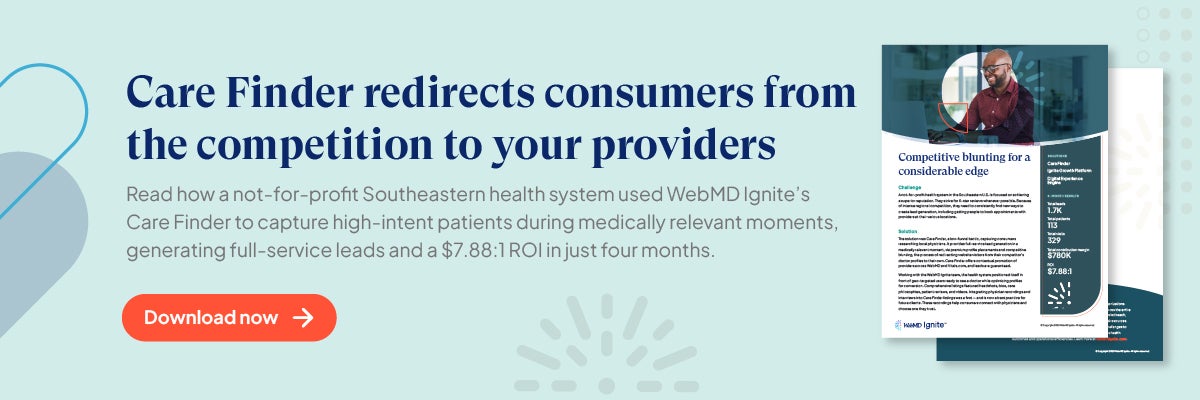
When a consumer lands on a competitor’s profile and is presented with (your) geographically relevant, in-market specialists, that isn’t disruption. It’s strategic SOV expansion at the precise moment of decision.
But visibility alone isn’t enough. Conversion depends on what happens next. Increasingly, the experience must be reinforced by AI-assisted provider biographies that synthesize verified credentials, claims-based expertise, and patient review sentiment into clear, contextual narratives. LLM-friendly FAQs and structured data enhance discoverability across AI-powered search environments. Profile pages should feature a strong CTA hierarchy, frictionless workflows, and visible appointment availability that aligns intent with inventory. With these elements in place, attention turns into confidence, confidence turns into action, and engagement becomes measurable conversion.
High-intent capture requires three elements:
- Contextual visibility, not generic exposure
Placement should reflect health consumers' intent, while they are actively researching their health (not after), specialty alignment, and geography in real time. Algorithmic surfacing within trusted health environments creates relevance that static directories cannot replicate. - Competitive SOV at the decision point
The most valuable traffic is already in motion. Named searches and specialty queries represent high-value traffic. Intercepting comparison behavior (ethically and strategically) protects market share and drives incremental leads that would otherwise convert elsewhere. - Conversion architecture, not just profile pages
Premium, action-oriented profile experiences reduce friction and guide consumers toward the next best step: call, schedule, or request an appointment. When paired with real-time appointability, the gap between intent and booked care shrinks dramatically.
Impressions and clicks alone do not drive growth. Scheduled appointments do. Retained patients do. Downstream revenue does. When acquisition strategies are tied directly to real-time engagement and conversion, the results are measurable, not theoretical.
This approach delivers higher call conversion, greater lead volume from existing traffic, stronger capture of named and specialty searches, and incremental share in competitive markets.
In an AI-powered landscape, growth does not come from being present everywhere. It comes from winning the medically relevant moments where decisions are made — and ensuring that when care seekers are ready to act, your providers are not just visible, but positioned to be chosen.
Final thought
AI-driven search isn’t diminishing the importance of provider discovery; it’s redefining it. The mandate remains the same: protect market share, grow high-value service lines, and demonstrate revenue impact.
Healthcare marketers can’t rely on a static directory page in a dynamic decision environment. Influence must happen upstream, in the medically relevant moments where trust forms and decisions accelerate. Being found is only the beginning. Being chosen, before the shortlist is formed, is what protects and drives market share.
If your growth strategy still starts at the bottom of the funnel, it may already be too late. Healthcare systems that design for these early moments will outpace those that simply appear in them.
Capture high-intent demand, expand SOV at the moment of comparison, and convert engagement into measurable growth. Click here to learn more.
SOURCES
- Latest Healthcare SEO Statistics: [Trends and Metrics for 2025], SEO Sandwich, https://seosandwitch.com/healthcare-seo-stats/
- TOP HEALTHCARE MARKETING STATISTICS IN 2024, Amra & Elma, https://www.amraandelma.com/healthcare-marketing-statistics/
- ZIPDO EDUCATION REPORT 2026 Healthcare Marketing Statistics, Zipdo, https://zipdo.co/healthcare-marketing-statistics/
- Marketing In The Medical Industry Statistics, WifiTalents, https://wifitalents.com/marketing-in-the-medical-industry-statistics/