
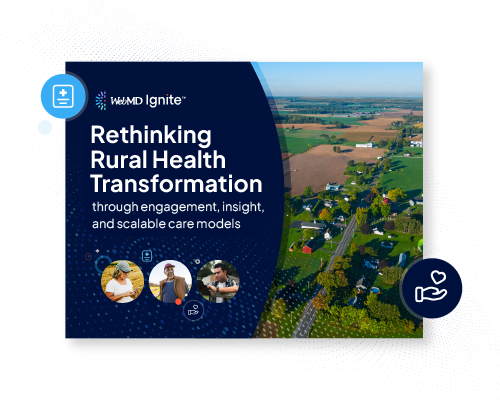

RHT Program, seven months in: what we're seeing

The RHT Program, seven months in: Our early read on the rollout
Executive summary: $10 billion a year through fiscal year 2030. Seven months since the first federal awards. The Rural Health Transformation (RHT) Program has moved from strategy to execution. The organizations positioning now are the ones setting the terms for what follows.
Here's what's happening on the ground: WebMD Ignite is monitoring the large volume of RFP and RFA opportunities, and states are diverging sharply in how they structure funding, governance, and procurement. The awards are out. The plans are filed. Rural health systems, FQHCs, and their partners are now translating federal intent into operational reality, with approaches already diverging across states.
The window for positioning is closing fast, and the cost of waiting is climbing with it.
This post lays out where things stand, what the funding landscape looks like right now, how states are diverging in ways that matter, and five early conclusions that should shape how rural health leaders and PMOs plan the next 90 days. This isn't a recap of what's already public. It's our read on what it means.
From strategy to implementation: what the first seven months looked like
The December-through-May arc tells a clear story. December brought the first federal awards and, with them, a compressed window to interpret state plans that were, in many cases, still being finalized. January and February accelerated the formation of alliances — some strategic, some opportunistic — as organizations recognized that the practical unit of competition was shifting. By March, the first RFPs had landed. By May, the pace had picked up considerably.
For organizations that had been watching and waiting, the timeline offered a kind of false comfort. Planning felt productive. But for many, the gap between readiness to respond and readiness to execute has become the most consequential variable in play.
The funding landscape: $10 billion annually through FY2030
The scale of the RHT Program deserves to be stated plainly. At $10 billion annually through FY2030, this is one of the most significant federal investments in rural health infrastructure in a generation. Individual state awards have ranged from $147 million to $281 million, a spread that reflects both population differences and the degree to which states arrived with mature, implementation-ready plans.
WebMD Ignite is currently tracking numerous live RFP/RFA opportunities, with additional possibilities anticipated in the near term. Recent submissions are currently under review. For finance and operations leaders, the math is worth sitting with: organizations that are building submission infrastructure and consortium relationships now aren't just ahead, they're establishing the institutional capacity that will define their competitive position for years.
The range of approaches is already wide
One of the defining features of the RHT rollout is how differently states are operationalizing federal intent. There is no single model. There are fifty distinct starting points, shaped by existing infrastructure, political will, and how aggressively states engaged during the planning phase. Funding is flowing through direct state procurements, provider grants, regional hub awards, and consortium-led structures — and the PMOs, fiscal intermediaries, and regional anchors selected today will shape much of what follows downstream.
- Tennessee scheduled nine consecutive funding opportunities from May through August, generally with 30-day application windows.
- North Carolina selected locally governed ROOTS networks across its six Medicaid regions to serve as programmatic and fiduciary leads.
- Utah is selecting a lead fiscal entity for a rural health consortium that will oversee up to $59.2 million across infrastructure, financial sustainability, technology, AI, and interoperability.
- Minnesota has issued separate opportunities spanning telehealth access, workforce development, health IT advisory services, performance measurement, and implementation support.
The takeaway isn't that one approach is superior. It's that generic positioning doesn't survive contact with state-level specificity. Organizations entering these markets need state-level intelligence, not just federal-level familiarity.
Five early conclusions for partners and PMOs
1. RHT is unfolding as 50 distinct operating models
Federal program design created a framework. States are creating the actual operating environment. That variance isn't a bug. It reflects the program's explicit flexibility. But for organizations operating across multiple states, internal consistency in approach is less valuable than state-specific fluency. Partners who mapped state plans early are translating that investment into a material competitive advantage right now.
2. The practical unit of competition is increasingly the consortium
Solo submissions remain, but the strongest responses increasingly come from consortia that combine local credibility, implementation capability, and clear governance. For C-suite leaders, the question is no longer whether to pursue these partnerships, but which ones to build — and on what terms.
3. Execution readiness is becoming a primary differentiator
Early rounds are surfacing a consistent pattern: organizations that demonstrated implementation capacity, not just programmatic vision, are winning awards. Reviewers are pressing on staffing plans, data systems, and governance structures with a specificity that earlier federal programs didn't require. For PMOs, this means the submission process has effectively moved upstream. Proposal development now requires having answers to operational questions that many organizations haven't yet addressed.
4. Engagement belongs at the center of implementation
Engagement isn't a compliance checkbox. It's a core delivery requirement. States scoring submissions rigorously treat engagement capacity as a program essential, not an add-on. Organizations that demonstrate sustained, structured engagement infrastructure are seeing it affect both award outcomes and Year 1 performance.
5. Measurement is no longer optional or downstream
RHT reporting frameworks are more demanding than most organizations expected. States require not just outcome data but the infrastructure to collect and report it in near-real time. Build that infrastructure now — it protects Year 2 funding and your standing as a long-term partner.
What this means for the next 90 days
The organizations seeing the clearest path forward share a few common operating practices.
A quarterly rolling view.
Static annual planning is too slow for a program moving at RHT's pace. The organizations navigating this most effectively are operating on a 90-day rolling horizon — reassessing pipeline, positioning, and team capacity on a quarterly basis.
Deliberate team assembly.
RHT implementation requires skills few organizations have fully in-house: federal program expertise, state-level relationships, clinical operations depth, data infrastructure, and community engagement. The decisions you make now about team composition will shape execution capacity through Year 2.
Governance built for speed.
Consortium arrangements succeed or fail on governance design. Decision rights, financial flows, performance accountability, and exit provisions need to be explicit before the award — not negotiated under the pressure of implementation timelines.
Year 1 and Year 2 as a single cycle.
Treating Year 1 as a learning phase is the most consequential mistake we're seeing. Reviewers are watching Year 1 performance as a signal of Year 2 readiness. Plan both years as one continuous cycle — not sequential phases — and you protect both your funding and your reputation.
What WebMD Ignite is working on
WebMD Ignite has been working in rural health markets for years, and the RHT Program represents the most significant structural investment in these communities in recent memory. Our focus right now is on helping organizations move from positioning to execution — specifically on the state-level intelligence, consortium strategy, engagement infrastructure, and measurement readiness that are determining competitive outcomes in the earliest rounds.
Our early conclusion is straightforward: RHT will reward orchestration. The organizations that connect state intent, local credibility, practical implementation, resident engagement, and measurable outcomes will be best positioned to convert this historic investment into lasting rural health infrastructure.
We're tracking the full RFP landscape across all active states, and monitoring early submissions closely for what they reveal about reviewer priorities and emerging best practices.
Let's talk about your next 90 days
If you’re a C-suite leader at a rural health system, FQHC, or partner organization deciding where to focus next, we’d welcome a practical working session on where you stand and what the next 90 days should look like. Click here to sign up and join the discussion.